What Happened to Anthropic: Full 2026 Timeline & Claude API Story
Anthropic is alive, well, and one of the top AI labs in 2026 — but the Claude API, pricing, and tier system have shifted fast. Here is the full story of what happened to Anthropic from 2021 to today.
So, what happened to Anthropic? The short take: Anthropic is alive, well, and still one of the top AI labs on the planet. But a lot has shifted since 2021. The Claude API has moved fast. Models came and went. Prices changed. Tiers were renamed twice. This guide lays out the full story in plain words.
You will see the key events year by year. You will see what changed for Claude API users. You will also see what to do if your stack leans on Claude. Each fact links to a primary source or to a deep dive on our site.
The short answer: what happened to Anthropic
Anthropic did not shut down. Anthropic did not get bought. Anthropic kept going. The firm is now one of the top three AI labs in the world, next to OpenAI and Google DeepMind. What changed is the pace. Claude shipped six core models in five years. Two big cloud deals reshaped the firm. The Claude API got new tiers, new prices, and new tools.
But the rapid pace has caused real pain for some teams. Some asked, what happened to Anthropic Claude 2? Why is the old API rate so much lower? Why did the Opus 3.5 tier vanish? This guide answers each of those.
For a full status check, see our is Anthropic dead page and our Anthropic tool profile.
A quick timeline of what happened to Anthropic
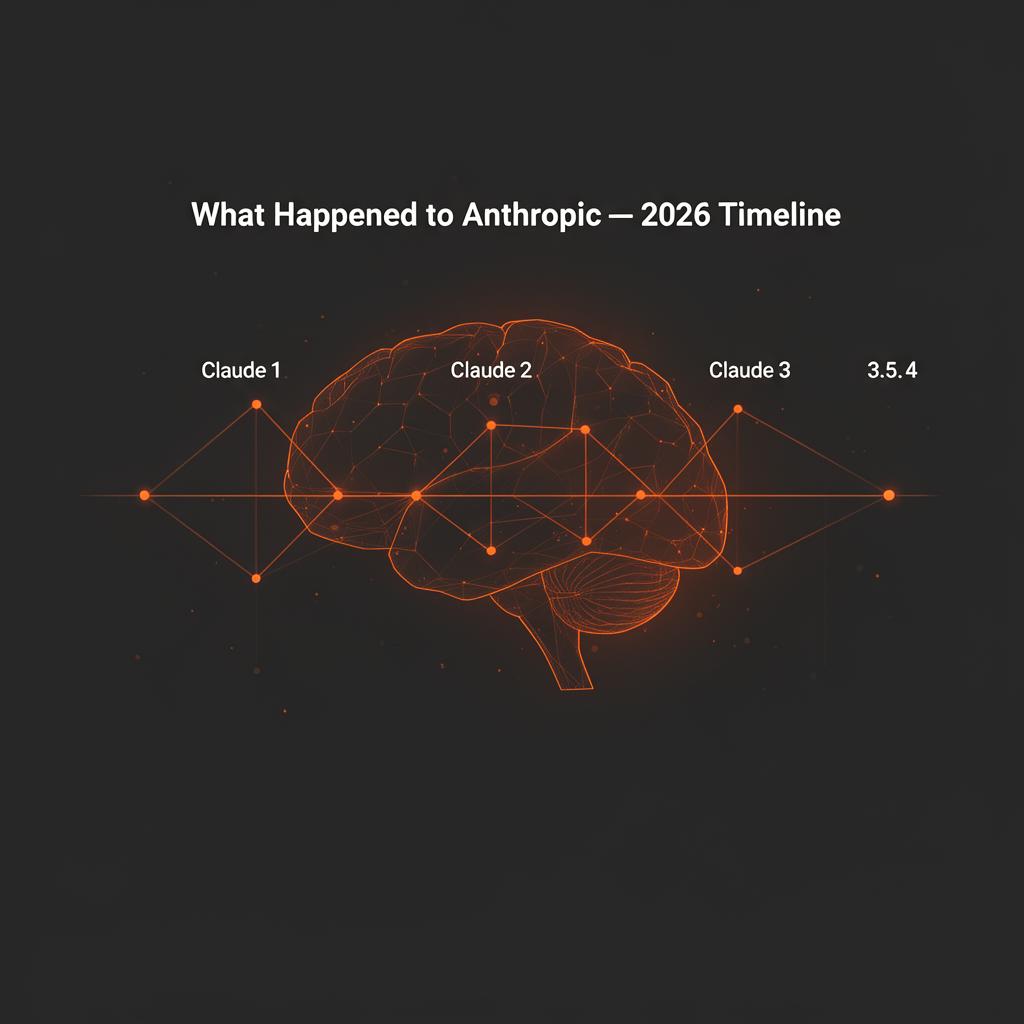
The chart below shows the key events from the Anthropic founding in 2021 to today. Each dot is a major shift for the firm or for the Claude API.
What this chart tells you: the pace of change is fast. A new core Claude model has shipped each year. Two big cloud deals locked in AWS and Google as Claude hosts. The latest era is the Claude 4 family, with Sonnet 4.5 as the lead model.
How Anthropic was founded
Anthropic was founded in 2021 by Dario and Daniela Amodei. Both were ex OpenAI staff. They left over a split on safety and pace. The firm raised $124 million in its first round. Most early staff came from OpenAI as well. The team set out to build a more steerable, safer kind of LLM. The result was Claude.
Claude was first shown in a closed alpha in late 2022. Slack was the launch partner. The first public API came in early 2023. By mid 2023, Claude 2 was live with a 100K token window. That was the largest in the field at the time.
What changed for Claude API users
The Claude API has shipped many small changes that add up. If you have not used the API in a year, here is what is new in 2026.
- New model names. The Claude 3 family came in 2024. The tiers were Haiku, Sonnet, and Opus. The Claude 4 family kept the same three names. So Sonnet 3.5 is now Sonnet 4.5.
- Prompt caching. Long, fixed prompts are now cached for cheap. Cached input tokens cost about 10% of the base rate. This cut costs by half for most agent loops.
- Message Batches. Bulk jobs now run via the Batches API. Each batch is 50% off the live rate. The trade off is a 24 hour cap.
- Tool use. The function call API is now stable. JSON mode is on by default. Most teams use it for agent loops.
- Computer Use. A beta API lets Claude click, type, and read a screen. It is slow and pricey. But it works for real tasks.
- MCP. The Model Context Protocol is now the open way to plug Claude into apps. Cursor, Zed, and many IDEs ship MCP support out of the box.
For a deep look at why some teams swap, see our Anthropic alternatives guide.
The Claude model lineup in 2026
The matrix below shows which Claude models are live, legacy, or gone in 2026.
What this matrix means for your code: most teams should pin to Sonnet 4.5 for daily work. Use Haiku 4.5 for cheap, fast jobs. Use Opus 4 for hard reasoning tasks. The Claude 3 family still works, but it is on a sunset clock. The 3.5 Opus tier was retired in 2025.
For more on the API, see the Anthropic docs.
What happened to Anthropic pricing
Pricing has moved a lot. The headline rate per million tokens is much lower than it was in 2023. But the new tier system can be hard to read. Here is the gist.
- Haiku 4.5: $1 in, $5 out per million tokens.
- Sonnet 4.5: $3 in, $15 out per million tokens.
- Opus 4: $15 in, $75 out per million tokens.
- Cached input: about 10% of the base rate.
- Batched output: 50% of the base rate.
The Claude Pro plan for chat is $20 a month. The Team plan is $25 per seat per month. The Enterprise plan is custom. Most firms with 50 or more seats land on Enterprise.
The price drop has been huge for Haiku and Sonnet. Opus, on the other hand, has gone up. Hard reasoning is now a clear premium tier. This is part of what happened to Anthropic in 2025: the firm split its pricing into a value tier and a premium tier.
What happened to Anthropic funding
Anthropic raised more than $13 billion in cash and cloud credits between 2023 and 2026. The two biggest checks came from AWS and Google.
- AWS: $4 billion across two rounds. AWS is now the lead cloud host for Claude.
- Google: $2 billion in cash plus credits. Google Cloud is the second host.
- Other rounds: Spark Capital, General Catalyst, and Salesforce Ventures all joined later rounds.
The funding made Anthropic one of the best capitalized AI labs in the world. The firm now spends more than $5 billion a year on training and staff. Revenue is on track to clear $4 billion in 2026, per public reports from The Information and Reuters.
Outages and trust
The Claude API has had a few rough patches. Most were short. None were the kind of multi day outage that hits other clouds. The full log is on status.anthropic.com. The biggest event was a 4 hour Sonnet outage in March 2025 that hit US East users.
The trust story is mostly clean. Anthropic ships a clear safety report each year. The firm is on the NIST AI Risk Framework board. Claude is also one of the few models with a public Responsible Scaling Policy.
What to do if your stack leans on Claude
A swap or a hedge is wise for any team that depends on one model. Here is the clean play.
- Pin your model. Do not call the bare
claude-3-sonnetalias. Pin to a dated build likeclaude-sonnet-4-5-20251022. - Cache your prompts. Use the prompt cache for any long, fixed system prompt. The cost cut is huge.
- Add a fallback. Wire in GPT-5, Gemini 2.5 Pro, or a Mistral model as a backup. Use a router like OpenRouter or LiteLLM.
- Watch deprecations. Sub to the Anthropic docs feed. The firm gives a 6 month notice before it sunsets a model.
- Test on Bedrock and Vertex. Same Claude weights, but with a different cloud bill and SLA. AWS and Google often beat the direct Anthropic rate at scale.
For more on each step, see our best tools like Anthropic guide and our take on why Anthropic failed (spoiler: it didn't).
Final word on what happened to Anthropic
So, what happened to Anthropic in the end? The firm grew up. It went from a tiny lab to a top three AI shop in five years. Claude went from a closed alpha to a $4 billion run rate API. Prices fell on Haiku and Sonnet. Opus moved to a premium tier. The Claude 3 family is on a sunset clock. The Claude 4 family is the new default.
For most teams, the right move in 2026 is simple. Pin to Sonnet 4.5. Cache your long prompts. Add a fallback model. Watch the deprecation feed. Do that, and Claude will keep working for you for a long time.
For more, browse our blog or check the full Anthropic profile.
Frequently Asked Questions
Is Anthropic still active in 2026?
Yes. Anthropic is one of the top three AI labs in the world in 2026, next to OpenAI and Google DeepMind. The Claude API is live and the firm has more than $13 billion in funding. Revenue is on track to clear $4 billion in 2026. Anthropic did not shut down or get bought.
What happened to Claude 2 and Claude 3?
Claude 2 was retired in 2024. The Claude 3 family is on a sunset clock and most tiers will be cut by late 2026. The Claude 3.5 Opus tier was retired in 2025. Most teams should pin to a Claude 4 dated build like Sonnet 4.5 for daily work.
Did Amazon or Google buy Anthropic?
No. Both Amazon and Google have invested in Anthropic, but neither owns the firm. AWS put in $4 billion across two rounds. Google put in $2 billion in cash and cloud credits. Anthropic is still a private firm led by Dario and Daniela Amodei.
Why did Anthropic raise its prices on Opus?
Anthropic split its tiers into a value plan and a premium plan in 2025. Haiku and Sonnet got cheaper. Opus moved to a premium tier at $15 in and $75 out per million tokens. The shift is part of what happened to Anthropic as it scaled to enterprise buyers who pay more for hard reasoning.
What is the best Claude API model to use in 2026?
Sonnet 4.5 is the best default Claude API model for most teams in 2026. Use Haiku 4.5 for cheap, fast jobs like classification or short replies. Use Opus 4 for hard reasoning tasks like code review, legal work, or deep research. Pin to a dated build to avoid surprise drift.
Is the Claude API safe and reliable?
Yes, for most teams. The Claude API has a clean uptime log on status.anthropic.com. The biggest outage was a 4 hour Sonnet event in March 2025. Anthropic ships a yearly safety report and is on the NIST AI Risk Framework board. SOC 2 Type II and HIPAA are both live.