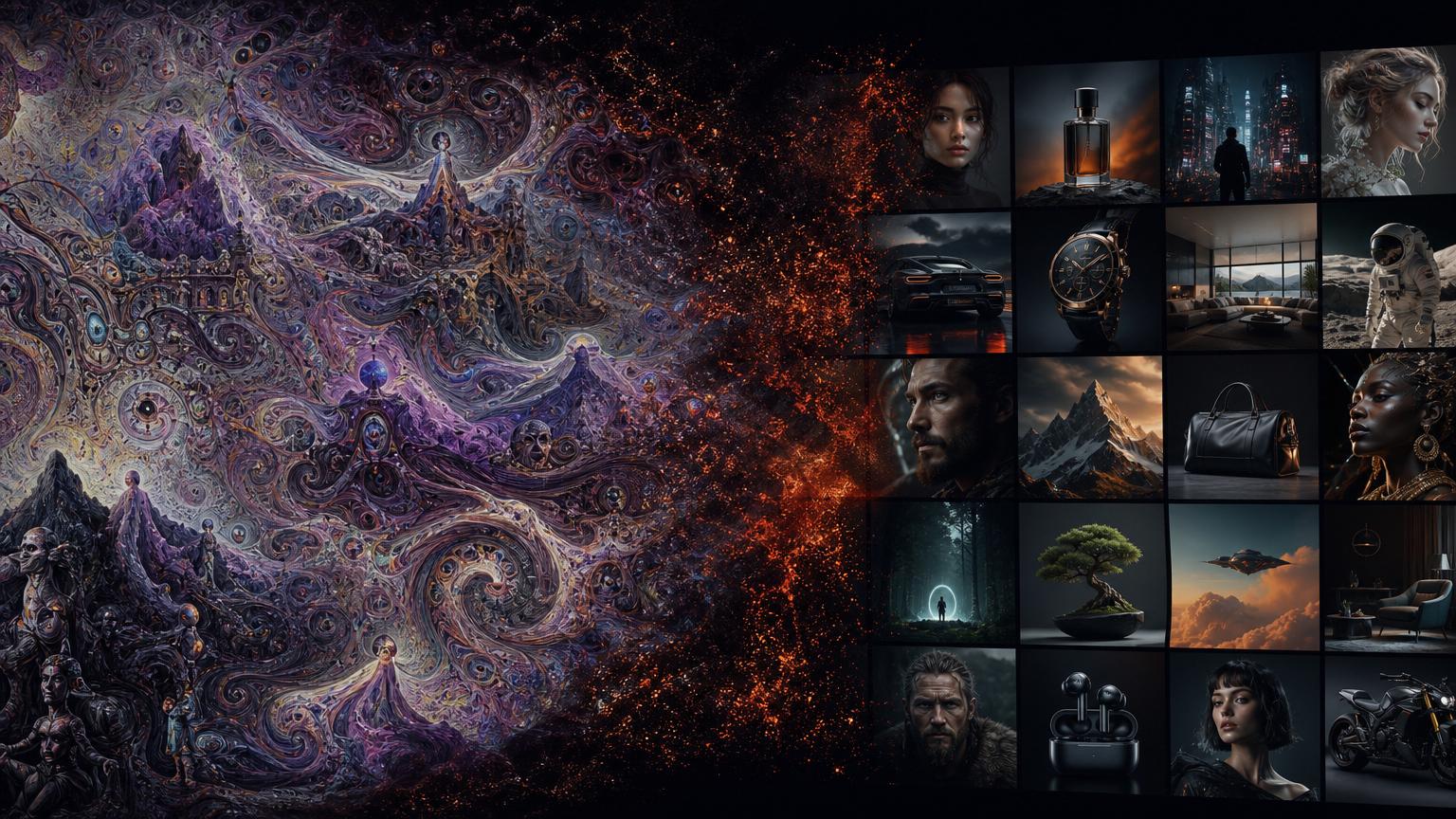
8 Best AI Image Generators Like Disco Diffusion in 2026
Disco Diffusion pioneered the CLIP-guided, painterly, hallucinatory AI art aesthetic that a whole generation of digital artists learned on — but modern latent diffusion models like Midjourney, Stable Diffusion, and Deforum now produce sharper, faster, more coherent images and animations than any Colab notebook. Midjourney Basic at $10/mo is the closest painterly replacement, Stable Diffusion is the free open-source pick with a huge plug-in ecosystem, Deforum for Stable Diffusion is the direct spiritual successor for animation mode, DALL·E 3 inside ChatGPT Plus is the best prompt-accurate chat option, Leonardo.Ai at $12/mo nails concept art and worldbuilding, NightCafe brings back the community remix energy, Runway Gen-3 covers real text-to-video, and Adobe Firefly is the commercial-safe pick with a clean license. These eight tools like Disco Diffusion, ranked by use case with a price chart, capability matrix, decision tree, and migration playbook, cover every reason a Disco Diffusion veteran is looking for a new home in 2026.
Looking for the best tools like Disco Diffusion in 2026? You are in the right place. Disco Diffusion — shipped in 2021 by Somnai as a Google Colab notebook built on CLIP-guided diffusion — was the tool that turned a whole generation of digital artists into AI artists. Its dreamy, painterly, hallucinatory landscapes and slow psychedelic zoom animations defined the pre-Midjourney era of generative art. Then the wave broke. Stable Diffusion shipped in August 2022, Midjourney hit V3 and V4, and the entire community moved onto faster, sharper, more prompt-accurate models within months. The Disco Diffusion Colab still runs, but the frontier — and the daily-active user base — is elsewhere.
That leaves thousands of Disco Diffusion veterans — VJs who loved the zoom loops, concept artists who used it for moodboards, indie musicians who generated album art, and hobbyists who spent nights babysitting Colab renders — looking for a modern generator that still feels magical. This guide ranks the eight best tools like Disco Diffusion by use case in 2026. Each pick gets a clear best-for, a current price, and an honest verdict. You also get a pricing chart, a 60-second decision tree, a capability matrix, a migration playbook, and an 8-question FAQ. By the end you will know which generator to open tonight — and which pair fits your workflow long-term.
Why people seek tools like Disco Diffusion
Disco Diffusion is not dead — the notebook still runs. But the reasons its users are shopping around in 2026 are concrete.
- Diffusion has moved past CLIP-guided iteration. Modern latent diffusion models — Stable Diffusion, SDXL, Flux — produce sharper images in seconds, not the 20–40 minutes a Disco Diffusion render used to take on a free Colab GPU.
- Prompt accuracy is a full generation ahead. Disco Diffusion's outputs were beautiful but loose — you could not reliably render text, hands, or specific compositions. DALL·E 3 and Midjourney V6 nail all three.
- Colab is not a product. Disco Diffusion lives in a Jupyter notebook that a user has to run, tune, and debug every session. Modern tools like Midjourney and Leonardo.Ai ship polished web apps.
- Speed matters. A single Disco Diffusion image was measured in minutes; a Midjourney or SDXL image is measured in seconds. That difference reshapes how you iterate.
- Animation moved to Deforum, then to real video models. The zoom-loop and animation-mode workflow Disco Diffusion pioneered is now Deforum for Stable Diffusion — and beyond that, real text-to-video models like Runway Gen-3, Sora, and Kling.
- Commercial licensing is unclear. Disco Diffusion is MIT-licensed code, but the CLIP/OpenAI-guided training data question was never cleanly resolved. Adobe Firefly sidesteps that by training on licensed content and shipping a full commercial license.
If any of that applies, the picks below cover the swap. For wider context, see our tools/disco-diffusion live profile and the comparisons hub.
Pricing at a glance
The chart below ranks monthly starter-tier prices for the top image generators like Disco Diffusion with the premium features that matter — full commercial license, unlimited or generous daily use, and access to the current-generation model. Two caveats. First, most tools on this list ship a usable free tier; prices shown are the cheapest paid tier where you get the "creator-grade" experience. Second, Stable Diffusion and Deforum are fully free if you self-host, and a few dollars a month on a hosted UI.
A few notes. Midjourney Basic at $10/mo unlocks ~200 fast generations, the web UI, and full commercial use. DALL·E 3 is bundled inside ChatGPT Plus at $20/mo — you get image generation plus GPT-5 for one bill. Leonardo.Ai Apprentice at $12/mo unlocks 8,500 monthly tokens. Adobe Firefly at $9.99/mo includes 2,000 generative credits and a full commercial license. NightCafe starts at $5.99/mo. Runway at $15/mo unlocks Gen-3 Alpha video alongside the image tools. Every option here matches or beats the effective cost of Disco Diffusion once you factor in Colab Pro GPU time.
The top 8 image generators like Disco Diffusion in 2026
Here are the eight AI image generators we rank as the best Disco Diffusion alternatives. Each pick has a use case, a current price, and a quick take on what makes it stand out.
1. Midjourney — best overall for painterly, gallery-grade AI art
Midjourney is the pragmatic answer for most Disco Diffusion users in 2026. Midjourney V6 — and the newer V7 alpha — ships the best out-of-the-box aesthetics of any general-purpose image model. The web app at midjourney.com replaced the old Discord-only workflow, so you can now generate, edit, and organize without leaving the browser.
Midjourney beats Disco Diffusion on three counts. First, image quality is a full generation ahead — Midjourney handles lighting, composition, and coherence at a level Disco Diffusion cannot reach. Second, speed — a Midjourney render is 30–60 seconds versus 20–40 minutes for a comparable Disco Diffusion output. Third, the community gallery replaces the Reddit-and-Discord scroll with a first-class remix and browse feed. Where Midjourney loses to Disco Diffusion: no true animation mode, no local install for offline work, and no free tier since 2023. For 80% of Disco Diffusion refugees who want the best possible still image, Midjourney is the right first stop. See the tools/midjourney live profile.
2. Stable Diffusion — best free open-source model
Stable Diffusion from Stability AI is the pick if you want full control, zero recurring cost, and the plug-in ecosystem that Disco Diffusion tinkerers loved. The current Stable Diffusion 3.5 and SDXL models are free to download and run on any modern GPU. The community around it is enormous — Civitai alone hosts tens of thousands of fine-tuned checkpoints.
Stable Diffusion beats Disco Diffusion on flexibility — you can inpaint, outpaint, run ControlNet, swap LoRAs, and script batches the way you used to script Disco Diffusion cells. It also beats Disco Diffusion on speed by 10–100× on the same hardware, and on commercial rights (the OpenRAIL license permits most commercial use). Where Stable Diffusion loses to Disco Diffusion: a real learning curve on the UI (ComfyUI or Automatic1111), you need a decent GPU or a hosted service, and the "vanilla Disco look" is not a default aesthetic — you rebuild it with prompts and LoRAs. For tinkerers and developers, Stable Diffusion is the right pick. See our best tools like Stability AI roundup for adjacent options.
3. Deforum for Stable Diffusion — best direct spiritual successor for animation
Deforum is the pick if what you loved about Disco Diffusion was the animation mode — the zoom-out landscape, the slow rotation, the hallucinatory dolly. Deforum is a free extension for Stable Diffusion WebUI that adds keyframable 2D and 3D camera motion, prompt schedules, and depth-warped motion — the exact features that made Disco Diffusion's disco_diffusion_animation.ipynb a cult classic.
Deforum beats Disco Diffusion on quality and speed — each frame is a full SDXL or SD 1.5 render, not a slow CLIP-guided iteration. It also beats Disco Diffusion on control — you get real keyframes on translation, rotation, zoom, and prompt weight across a timeline. Where Deforum loses to Disco Diffusion: setup takes an afternoon (install SD WebUI, install Deforum, install FFmpeg), you need a local GPU or paid cloud, and the parameter surface is even larger. For VJs, motion designers, and anyone who used Disco Diffusion specifically for animation, Deforum is the right pick.
4. DALL·E 3 — best for prompt accuracy inside ChatGPT
DALL·E 3 from OpenAI is the pick if you already pay for ChatGPT Plus and want image generation that actually renders what you type. DALL·E 3 is bundled inside ChatGPT Plus at $20/mo — ChatGPT rewrites your prompt behind the scenes, so a rough sentence becomes a detailed generation prompt automatically.
DALL·E 3 beats Disco Diffusion on prompt accuracy — it renders text-in-image, follows multi-part prompts, and handles compositional layouts better than any CLIP-guided tool. It also beats Disco Diffusion on convenience — one chat window generates, edits, and iterates. Where DALL·E 3 loses to Disco Diffusion: the painterly hallucinatory aesthetic is missing, animation is not supported, and image generation now runs through the gpt-image-1 API rather than a public-facing DALL·E product. For ChatGPT-first users who want image generation as a chat feature, DALL·E 3 is the right pick. See our best tools like DALL·E mini roundup for related picks.
5. Leonardo.Ai — best for stylized concept art
Leonardo.Ai is the pick if you used Disco Diffusion for concept art, moodboards, and worldbuilding. Leonardo ships a full canvas app with Character Reference, Style Reference, and Content Reference — the modern equivalents of Disco Diffusion's init-image and CLIP-prompt weighting, but with SDXL-class quality. Apprentice at $12/mo unlocks 8,500 monthly tokens.
Leonardo beats Disco Diffusion on stylistic control — dozens of fine-tuned models for anime, isometric game art, environments, and photorealism. It also beats Disco Diffusion on iteration speed — variations feel like a rapid-fire remix loop, and each child is a full high-res image. Where Leonardo loses to Disco Diffusion: no CLIP-guided iteration workflow, a slightly more corporate UI, and the token system takes a while to intuit. For indie game devs, concept artists, and worldbuilders, Leonardo.Ai is the right pick.
6. NightCafe — best community remix experience
NightCafe is the pick if what you loved about the Disco Diffusion era was the community — swapping prompt notebooks on Reddit, screenshotting each other's renders, running daily challenges. NightCafe hosts a live feed of generations, lets you fork any public image, and runs daily challenges. AI Beginner at $5.99/mo unlocks 100 credits.
NightCafe beats Disco Diffusion on community energy — the daily challenges feel like Disco Diffusion's 2021 heyday, but with modern models under the hood (Stable Diffusion, SDXL, Flux, and DALL·E 3 all live in one UI). Where NightCafe loses to Disco Diffusion: image quality is a step below Midjourney or Leonardo on painterly work, the credit system slows exploration, and there is no first-class API. For hobbyists who want the vibe of Disco Diffusion with better models, NightCafe is the right pick.
7. Runway Gen-3 — best for image plus video workflows
Runway is the pick if you loved Disco Diffusion for motion and want to graduate to real text-to-video. Runway ships Frames for still images and Gen-3 Alpha for text-to-video and image-to-video — the 2026 equivalent of what Disco Diffusion animation mode promised in 2021. Standard at $15/mo unlocks 625 credits.
Runway beats Disco Diffusion on motion quality — Gen-3 renders coherent five-to-ten-second clips with real camera moves, not the frame-warped psychedelia of Disco Diffusion animation. It also beats Disco Diffusion on production polish — Runway targets film, ads, and social video, so the export options are broadcast-ready. Where Runway loses to Disco Diffusion: pure still-image generation is less refined than Midjourney, credits burn fast on video work, and the "hallucinatory zoom loop" aesthetic requires more prompt engineering. For creators who need stills plus motion, Runway is the right pick.
8. Adobe Firefly — best commercial-safe generator with a full license
Adobe Firefly is the pick if you sell your art, license it to clients, or ship it inside commercial products. Firefly is trained on Adobe Stock, openly licensed content, and public-domain images — no scraped-web dataset — and Adobe indemnifies enterprise customers against IP claims on Firefly output. Firefly Standard at $9.99/mo bundles 2,000 generative credits.
Firefly beats Disco Diffusion on commercial confidence — the license is unambiguous, the training data is documented, and Adobe backs it in writing. It also beats Disco Diffusion on integration — Firefly is baked into Photoshop's Generative Fill, Illustrator's Generative Recolor, and Express. Where Firefly loses to Disco Diffusion: the aesthetic is safer than Midjourney or Leonardo, no true animation mode, and community remix is minimal. For agencies, marketers, and any team shipping paid work, Firefly is the right pick.
Capability matrix — what each tool ships
Use this matrix to filter by capability before pricing. The capabilities below are the ones Disco Diffusion veterans most often want to match on a replacement.
A few things this matrix hides. "CLIP look" means the tool can produce the painterly, dream-like aesthetic Disco Diffusion was famous for. "Animation" means built-in support for multi-frame or video output. "Custom models" means you can load LoRAs, fine-tunes, or your own checkpoints. "Commercial" means the paid tier ships a clear commercial license. "Free tier" means a usable free plan for daily generation. "API" means a stable public API for developers. Pick on the capability that actually breaks your workflow, not the longest checkmark row.
Decision tree — pick in 60 seconds
If the matrix did not narrow it down, follow the tree.
The shortest version: Midjourney is the pick if you want the best painterly image quality. Stable Diffusion is the pick if you want free and open source. Deforum is the pick if you loved Disco Diffusion's animation mode. DALL·E 3 is the pick if you already pay for ChatGPT. Leonardo.Ai is the pick for concept art. NightCafe is the pick for community remix. Runway is the pick if you also need video. Adobe Firefly is the pick for commercial-safe output.
Side-by-side — at a glance
| Tool | Best for | Monthly price | CLIP look | Animation | Free tier |
|---|---|---|---|---|---|
| Midjourney | Painterly art | $10 (Basic) | Yes | No | No |
| Stable Diffusion | Open source | Free | Yes | Yes (Deforum) | Yes |
| Deforum (SD) | Animation | Free | Yes | Yes | Yes |
| DALL·E 3 | Prompt accuracy | $20 (Plus) | Limited | No | Limited |
| Leonardo.Ai | Concept art | $12 (Apprentice) | Yes | Yes (Motion) | Yes |
| NightCafe | Community remix | $6 (Beginner) | Yes | No | Yes |
| Runway Gen-3 | Image + video | $15 (Standard) | Limited | Yes | Yes |
| Adobe Firefly | Commercial-safe | $10 (Standard) | Limited | Yes | Yes |
Use this table as the final filter once you have a shortlist of two.
How to migrate off Disco Diffusion in 2026
Leaving Disco Diffusion is mostly about porting the visual references and prompt vocabulary you built up — your favorite renders, your init images, the artist tokens you leaned on — into a new tool without losing the look. The steps below cover a real switch end-to-end.
- Archive your Disco Diffusion renders. Download every image and every animation frame from your Google Drive Colab output folder. Grab your top 20–50 stills and any completed animations before you close the Drive.
- Save your prompt notebook. Disco Diffusion prompts were long, artist-heavy strings ("by James Gurney, by Beeple, trending on ArtStation…"). Copy your favorite prompt cells into a plain text file — most of that vocabulary still works verbatim in Midjourney, SDXL, and Leonardo.
- Pick one replacement, not three. The temptation is to sign up for Midjourney, Leonardo, and Deforum at once. Do not. Pick one for a two-week trial and let a real habit form before comparing.
- Seed the new tool with your look. On day one, upload your favorite Disco Diffusion outputs as Style Reference images (Midjourney), Style Reference uploads (Leonardo), or SDXL init images with 0.4–0.6 denoising strength. This anchors the new tool to your existing aesthetic.
- Translate init images to modern control. In Disco Diffusion you passed
init_imageandskip_steps. In Stable Diffusion the equivalents are img2img denoising strength and ControlNet conditioning; in Midjourney they are image prompts with weight. Keep a private cheatsheet. - Run a two-week trial. Use the new tool exclusively for 14 days. On day 14, look back at three things: did the output match your Disco Diffusion style, did the tool feel playful, did you actually open it as often as you opened Colab.
- Move highlights into a permanent style library. After two weeks, take the 5–10 outputs you are proudest of and save them as a Midjourney personalization set, a Leonardo style, or a Firefly project. This locks in your look for future work.
- Layer a second tool only if a real gap opens. Most users end up on one primary tool. If a real gap opens (e.g. Midjourney for portraits + Deforum for animation), layer a second — but only after four weeks on the first.
Most Disco Diffusion refugees in 2026 land on Midjourney as the primary daily driver for stills, with Deforum or Runway as a secondary tool when they need motion. That combination covers painterly quality, animation, and prompt accuracy without paying three subscriptions.
Frequently asked questions
The questions below come up the most when Disco Diffusion veterans compare replacements in 2026. Each answer is short enough to act on.
Final verdict
There is no single best tool like Disco Diffusion in 2026 — there is the best tool for what Disco Diffusion meant to you. For the closest all-round replacement with the best painterly quality, Midjourney Basic at $10/mo. For free and open source with the plug-in ecosystem, Stable Diffusion. For direct animation-mode succession, Deforum for Stable Diffusion. For prompt-accurate chat generation, DALL·E 3 inside ChatGPT Plus at $20/mo. For concept art and stylistic control, Leonardo.Ai at $12/mo. For community remix energy, NightCafe at $6/mo. For real text-to-video, Runway at $15/mo. For commercial-safe client work, Adobe Firefly at $10/mo.
The honest answer for most Disco Diffusion refugees is Midjourney as the primary daily driver — the painterly quality and speed are the clearest 2026 upgrade over Disco Diffusion's slow CLIP-guided renders — with Deforum or Runway as a second tool if you still need motion. For wider context, see our tools/disco-diffusion live profile, the best tools like Stability AI roundup, the best tools like DALL·E mini page, and the comparisons hub.
Frequently Asked Questions
What is the best alternative to Disco Diffusion in 2026?
It depends on what you loved about Disco Diffusion. For the closest painterly replacement, [Midjourney Basic](https://www.midjourney.com/plans) at $10/mo. For free and open source with full control, [Stable Diffusion](/tools/stable-diffusion). For animation-mode succession, [Deforum for Stable Diffusion](https://github.com/deforum-art/deforum-stable-diffusion). For concept art with fine style control, [Leonardo.Ai](https://leonardo.ai/) at $12/mo. Most Disco Diffusion refugees land on Midjourney as the primary tool. See our full [tools/disco-diffusion](/tools/disco-diffusion) profile.
Is Disco Diffusion still active in 2026?
The [Disco Diffusion Colab notebook](https://github.com/alembics/disco-diffusion) is still available and technically still runs, but active development slowed dramatically after [Stable Diffusion shipped in August 2022](https://stability.ai/news/stable-diffusion-public-release). The community moved to Stable Diffusion, Midjourney, and Deforum within a few months. Disco Diffusion works, but it is no longer where the frontier lives — see our [tools/disco-diffusion](/tools/disco-diffusion) live status page.
Is Disco Diffusion free? What does it cost?
The [Disco Diffusion notebook](https://github.com/alembics/disco-diffusion) is [MIT-licensed](https://github.com/alembics/disco-diffusion/blob/main/LICENSE) and free to use, but you pay for the GPU. On the free Google Colab tier renders time out after a few frames; on [Colab Pro](https://colab.research.google.com/signup) ($9.99/mo) or Pro+ ($49.99/mo) you get longer runtimes. In 2026 that money buys you more on paid tools — [Midjourney Basic](https://www.midjourney.com/plans) at $10/mo, [Leonardo.Ai Apprentice](https://leonardo.ai/pricing/) at $12/mo, or free self-hosted [Stable Diffusion](/tools/stable-diffusion) if you own a GPU.
What is the closest tool to Disco Diffusion's animation mode?
[Deforum for Stable Diffusion](https://github.com/deforum-art/deforum-stable-diffusion) is the direct spiritual successor — it ports the keyframable 2D/3D camera moves, prompt schedules, and depth-warped motion that made Disco Diffusion's `disco_diffusion_animation.ipynb` a cult classic. It runs on top of [Stable Diffusion WebUI](https://github.com/AUTOMATIC1111/stable-diffusion-webui) and produces sharper frames far faster. If you want real text-to-video instead, [Runway Gen-3](https://runwayml.com/research/introducing-gen-3-alpha) is the 2026 upgrade path.
Which Disco Diffusion alternative has the best commercial license?
[Adobe Firefly](https://www.adobe.com/products/firefly.html) has the cleanest commercial license — trained on [Adobe Stock and licensed content](https://helpx.adobe.com/firefly/faq.html) with enterprise IP indemnification. [Midjourney](https://www.midjourney.com/) grants full commercial rights on any paid plan. [DALL·E 3](https://openai.com/dall-e-3) grants commercial rights inside ChatGPT Plus. [Stable Diffusion](https://stability.ai/license) permits most commercial use under the OpenRAIL license. Disco Diffusion itself is MIT-licensed but the training data provenance was never fully clarified.
Is Midjourney or Stable Diffusion the better Disco Diffusion replacement?
[Midjourney](/tools/midjourney) is better if you want the highest painterly image quality with the least effort — its default aesthetic is a full generation ahead. [Stable Diffusion](/tools/stable-diffusion) is better if you loved Disco Diffusion for the tinkering — the notebooks, the parameters, the LoRAs and ControlNets. Most refugees who wanted the Disco look with less babysitting land on Midjourney; most who wanted the Disco Colab experience with better output land on Stable Diffusion with Deforum on top.
Can I recreate the Disco Diffusion look on modern tools?
Yes — the artist tokens and prompt style still work. In [Midjourney](/tools/midjourney) or [Stable Diffusion](/tools/stable-diffusion), prompts like `dreamy trippy landscape, hallucinatory, by James Gurney, by Beeple, trending on ArtStation, cinematic lighting` still evoke the Disco Diffusion aesthetic. For extra fidelity, upload a favorite Disco render as a [Style Reference](https://docs.midjourney.com/) (Midjourney) or an img2img init image with 0.4–0.6 denoising strength (SDXL). The 2026 output will be sharper but you can absolutely keep the vibe.
What happened to Disco Diffusion and why did it stall?
Disco Diffusion did not fail — it succeeded at a workflow ([CLIP-guided diffusion](https://arxiv.org/abs/2103.17249) in a Google Colab notebook) that the market rapidly moved past. When [Stable Diffusion shipped in August 2022](https://stability.ai/news/stable-diffusion-public-release) as a full latent diffusion model — 10 to 100× faster, sharper, and installable locally — the entire generative art community migrated within months. [Deforum](https://github.com/deforum-art/deforum-stable-diffusion) then absorbed the animation workflow. Disco Diffusion still runs, and the [notebook](https://github.com/alembics/disco-diffusion) is still MIT-licensed, but the mindshare and daily-active-user gravity permanently shifted.