How the Archive Verifies a Tool’s Pulse
Every tool on AI Tool Graveyard has a status and at least one source. This post explains how we choose a status and how we keep it up to date.
1. Start from a primary source
We use an official announcement whenever one exists, such as a company blog post, help-center notice, sunset page or press release. When there isn’t one, we use reputable news reporting. Each tool page links to the source we used. For example, the Sora page cites OpenAI’s own sunset notice.
2. Assign one of five statuses
- Active: operating normally.
- Acquired: bought by, or absorbed into, another company. The product may or may not continue.
- At risk: credible signals of trouble, such as an announced wind-down date, a feature lockdown, legal or financial distress, or the product being replaced.
- Abandoned: still online but no longer maintained, with no official shutdown.
- Shutdown: officially discontinued, or no longer usable.
3. Automated daily checks
A scheduled checker visits a batch of official tool URLs every day. It looks for problems such as errors, unreachable domains and unexpected redirects. If it finds one, it adds the tool to a human review queue. It never changes a status on its own. A broken page can be a temporary outage, so an editor confirms every change against a source first.
4. Re-check tools that are already dead
Shut-down tools change too. Domains get redirected and companies get acquired. DreamStudio now redirects to a different product, for example. That’s why tools marked as shut down stay in the checking cycle.
Spot a status that looks wrong? Use the contact details on our About page and include a source link.
5. What counts as a good source
From strongest to weakest:
- The company’s own announcement: a blog post, help-center article, sunset page, press release or regulatory filing
- Reporting from established outlets that quote the company, such as Reuters, The Verge, TechCrunch or MIT Technology Review
- A live check of the official website, which we use only to confirm that an active tool is still operating
For example, the Cody page cites Sourcegraph’s own blog post. The Galactica page cites MIT Technology Review. The Loom page cites Atlassian’s press release.
6. Edge cases we handle carefully
- Partial shutdowns. Sometimes only some plans close. When Cody Free and Pro ended, Cody Enterprise continued. We name exactly what closed.
- Closed, then back. HuggingChat closed “for now” in July 2025, but the chat page was live again when we checked. We record both facts.
- Licensing deals. Character.AI licensed its technology to Google but was not acquired, so it is marked active.
- Same name, different product. OpenAI’s 2021 Codex model and today’s Codex agent are different products. The page says which one we mean.
7. Dates and freshness
Every tool page shows a “Last verified” date. We re-verify whenever the automated checker flags a tool, when a reader reports a change, or when news breaks. Times on the site use the date of the source event, not the date we wrote about it.
8. What we don’t do
- We don’t guess at shutdowns from rumours or social media posts alone.
- We don’t accept payment to change a status.
- We don’t publish uptime claims. “Active” means the business and product are operating, not that there are no outages.
To report a change, use the Report a Tool form.
Related articles
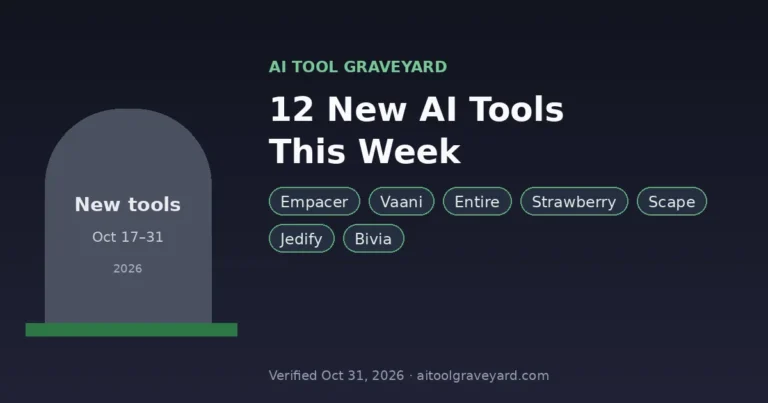
12 New AI Tools This Week (Oct 17–31, 2026): Agents, Browsers and Data Apps
Twelve new AI tools launched in the second half of October 2026, from voice agents and AI email to a…
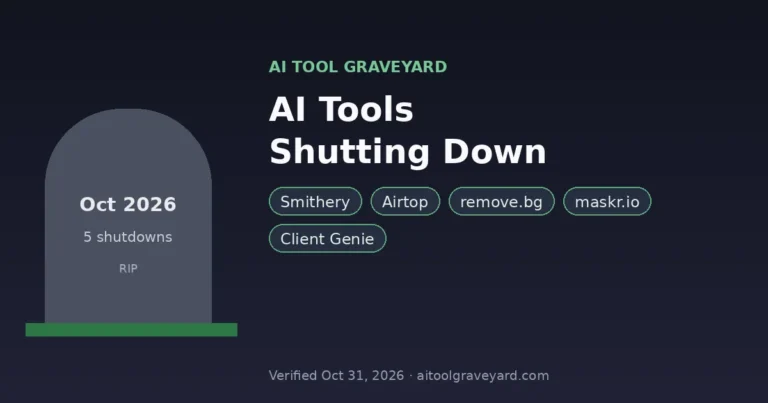
AI Tools Shutting Down: Smithery, Airtop, remove.bg and More (October 2026)
Smithery switched off its MCP hosting, maskr.io and Client Genie closed, Airtop ends on November 13 and remove.bg's standalone site…
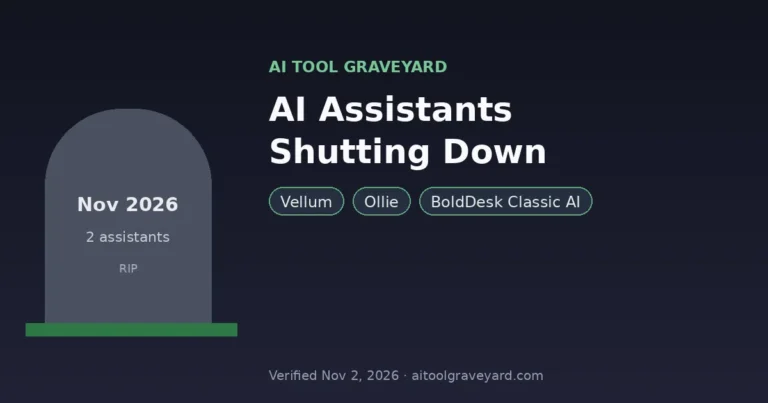
Vellum and Ollie Shut Down: Is Your AI Assistant Shutting Down? (November 2026)
Vellum switched off its hosted Personal Assistant Platform on November 2 and Ollie closes on November 6, 2026. What happens…